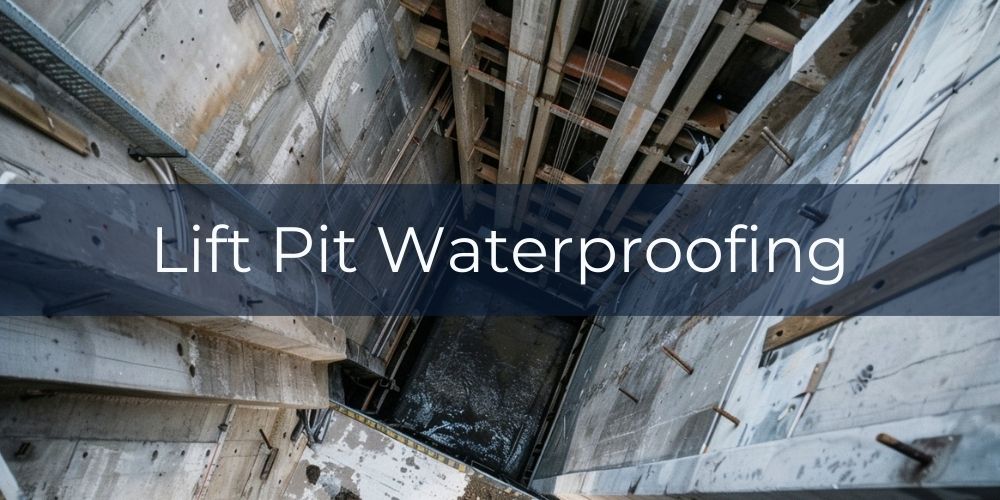
Structural Waterproofing delivers compliance-led lift pit waterproofing design support and installation coordination for UK buildings where lift pits, lift pit walls, lift pit bases, wall-to-base junctions, pit penetrations, sump details, and other lift pit interfaces must resist groundwater ingress, damp transmission, and long-term moisture-related deterioration. As lift pit waterproofing contractors, we support new-build and refurbishment projects across the UK, including commercial buildings, mixed-use developments, hotels, healthcare facilities, education estates, infrastructure-linked structures, and complex occupied assets where lift pit waterproofing must be engineered around real ground conditions, lift pit geometry, construction sequence, and long-term reliability at one of the lowest and most water-vulnerable points in the structure. Lift pit waterproofing is not simply a membrane or coating applied inside a pit. It is a coordinated lift pit waterproofing system in which membranes, liquid-applied barriers, cementitious treatments, waterbars, joint detailing, penetration seals, kicker details, sump interfaces, base returns, terminations, and protection measures must work together across the full lift pit enclosure. Lift pit waterproofing failure is usually driven by broken continuity at wall-to-base junctions, unresolved construction joints, untreated penetrations, weak terminations, damaged waterproof layers, poor substrate preparation, incompatible transitions between vertical and horizontal waterproofing, or loss of protection before surrounding works are completed. UK ground conditions therefore demand more than nominal product installation because lift pit waterproofing performance is determined by how the full lift pit waterproofing system resists moisture across lift pit walls, lift pit bases, joints, penetrations, sump details, and transitions without leaving concealed ingress pathways into the pit itself. Structural Waterproofing provides a complete lift pit waterproofing service, including lift pit waterproofing strategy support, buried membrane installation, liquid-applied lift pit waterproofing, cementitious treatment, construction-joint waterproofing, lift pit base and wall interface coordination, penetration detailing, remedial lift pit waterproofing investigation, and phased works for live and constrained sites. Each project is delivered with a focus on lift pit continuity, substrate readiness, interface control, sequencing, protection of completed work, and recorded treatment scope so the completed lift pit waterproofing system can be understood, verified, and relied upon over the building lifecycle.
What Is Lift Pit Waterproofing?
Lift pit waterproofing is the design, coordination, installation, and verification of waterproofing systems that protect a lift pit and its adjoining structural interfaces against groundwater ingress, damp transmission, and moisture-related deterioration. In UK practice, lift pit waterproofing is the part of below-ground waterproofing concerned specifically with keeping water out of the lift pit enclosure itself, including lift pit walls, lift pit bases, wall-to-base transitions, construction joints, penetrations, sump details, and other structural interfaces at the lowest level of the lift shaft. A typical lift pit waterproofing system may include self-adhesive or torch-applied membranes, liquid-applied barriers, bonded sheet systems, cementitious waterproof treatments, waterbars, joint seals, penetration detailing, protection boards, and controlled terminations where the waterproof layer must continue across changes in lift pit geometry and adjoining construction. Lift pit waterproofing fails when the protective layer is broken at wall bases, base transitions, kicker joints, construction joints, penetrations, sump interfaces, or membrane terminations, or when the substrate is unsuitable to receive durable bond or support continuity. For that reason, lift pit waterproofing must be engineered around groundwater conditions, lift pit exposure, pit geometry, substrate condition, joint density, penetration load, and construction logic rather than treated as generic below-ground membrane work. Effective lift pit waterproofing protects both the main lift pit surfaces and the critical details that determine whether the system performs once the pit is complete and operational. Ultimately, lift pit waterproofing converts a water-vulnerable lift pit enclosure into a continuous, durable, and coordinated protective system that supports long-term operational and structural moisture control.
Why Is Lift Pit Waterproofing Built for UK Buildings?
Lift pit waterproofing is built for UK buildings because lift pits are commonly located at some of the lowest and most water-vulnerable points in the structure, where persistent moisture, variable groundwater conditions, lateral pressure, and continuity-sensitive interfaces cannot be controlled reliably by isolated waterproofing measures alone. UK lift pits commonly present confined geometry, wall-to-base transitions, sump details, penetrations, construction joints, and buried exposure conditions that make system-level lift pit waterproofing essential from the outset of construction. A lift pit waterproofing system works by forming a continuous protective layer across the lift pit enclosure and carrying that layer through lift pit base transitions, construction joints, penetrations, sump details, and terminations before the surrounding structure is completed and the lift pit enters service. Its performance is therefore determined by lift pit continuity, base-level detailing, joint treatment, waterproof-layer integrity, sequencing, and protection of completed work rather than by the presence of one membrane or coating product alone. When the waterproof layer is damaged, interrupted, weakly terminated, or poorly coordinated at the lift pit interface, water can bypass the treated areas and enter the pit even where individual components appear technically suitable in isolation. Structural Waterproofing therefore builds lift pit waterproofing around real water exposure, lift pit geometry, enclosure continuity, base-level detailing, sequencing control, and durable protection so the completed system performs predictably across UK ground conditions.
This system-level lift pit waterproofing approach connects ground-risk assessment, waterproofing selection, lift pit continuity, wall-to-base interface control, construction sequencing, protection of completed work, and recorded installation into one coordinated lift pit waterproofing strategy.
- Structural Waterproofing designs lift pit waterproofing scopes around continuous protection across lift pit walls, lift pit bases, joints, penetrations, sump details, and terminations.
- Structural Waterproofing targets high-risk interfaces because wall-to-base junctions, construction joints, kicker details, service penetrations, corners, and sump-related terminations commonly determine residual lift pit waterproofing risk.
- Structural Waterproofing selects lift pit waterproofing according to groundwater exposure, lift pit form, substrate condition, joint density, and buried structural demands.
- Structural Waterproofing plans delivery around preparation, lift pit waterproofing installation, sequencing, protection of completed work, and follow-on trades so lift pit continuity is preserved through construction.
- Structural Waterproofing records treated zones, joint details, penetration locations, and transition scope so the lift pit waterproofing system can be understood and governed after completion.
These lift pit waterproofing decisions produce the following performance and assurance outcomes:
- System-level waterproofing scope control → aligns lift pit walls, lift pit bases, joints, penetrations, sump details, and terminations → lift pit waterproofing continuity is maintained across the full lift pit enclosure
- High-risk interface control → protects vulnerable wall-to-base transitions, joints, penetrations, sump interfaces, and terminations → local lift pit waterproofing failures are reduced before they develop into wider pit ingress pathways
- Appropriate waterproofing selection → matches the lift pit waterproofing system to groundwater conditions, substrate type, and pit form → lift pit waterproofing performance is aligned to real site conditions
- Sequencing and protection control → preserve continuity through installation, protection, and surrounding works → lift pit waterproofing integrity is preserved during construction
- Recorded treatment scope and interface information → show where lift pit waterproofing was installed and how critical pit details were formed → lift pit waterproofing can be reviewed, maintained, and relied upon over the building lifecycle
The lift pit waterproofing delivery process below expands these decisions in the same sequence, from lift pit continuity and interface risk through system selection, sequencing, and long-term reliability.
1. System-Level Scope Control Around Full Lift Pit Waterproofing Continuity
Structural Waterproofing engineers lift pit waterproofing as a complete lift pit waterproofing system rather than as isolated membrane or coating application on selected pit surfaces. Lift pit waterproofing performance is not determined by whether a waterproof layer exists somewhere on a lift pit wall. It is determined by whether continuity is maintained across the full lift pit enclosure, including lift pit walls, lift pit bases, wall-to-base junctions, construction joints, service entries, corners, sump details, and terminations, without leaving concealed pathways for water to bypass the treated structure. A lift pit can contain technically suitable waterproofing materials and still fail if the overall scope has not resolved how the barrier continues through changes in lift pit geometry, connects between vertical and horizontal surfaces, or transitions across adjoining structural elements at pit level. For that reason, lift pit waterproofing scope must be defined against real lift pit form, actual groundwater exposure, interface density, and the exact locations where continuity is most likely to break. Structural Waterproofing therefore sets lift pit waterproofing scope around enclosure-wide continuity so lift pit walls, lift pit bases, joints, penetrations, sump details, and edge interfaces work as one coordinated waterproofing system rather than as isolated treated areas.
2. High-Risk Interface Control at Wall Bases, Joints, Penetrations, Sump Details, and Terminations
Residual lift pit waterproofing risk is concentrated at interfaces because interfaces are where continuity is easiest to lose. Wall-to-base junctions, kicker details, construction joints, service penetrations, sump details, corners, and membrane terminations all create conditions where groundwater can bypass otherwise sound lift pit waterproofing if detailing is incomplete or incompatible. These locations combine geometry change, variable substrates, multiple trades, sequencing pressure, and local vulnerability during surrounding construction, which is why they so often determine actual performance in a completed lift pit. Water does not need full-system failure to enter the enclosure. It only needs one unresolved penetration, one weak wall-to-base transition, one broken joint detail, one poor sump interface, or one damaged termination at a critical point. Structural Waterproofing therefore treats base-level and interface control as central to lift pit waterproofing performance, coordinating local details so the wider protective strategy is not undermined by unresolved junction conditions.
3. Lift Pit Waterproofing Selection Aligned to Groundwater Exposure, Pit Form, and Lowest-Level Conditions
A lift pit waterproofing system must be selected according to how water is expected to act on the lift pit enclosure, how the pit is formed, and how the completed building depends on dry and reliable lift pit operation in use. Some lift pits require membrane-based barrier protection carried continuously across lift pit walls, base transitions, and pit-edge interfaces. Others may require liquid-applied systems or cementitious treatment where confined geometry, substrate form, or detail concentration make direct bonded protection more suitable. In more demanding ground or structural conditions, combined detailing measures may be necessary across joints, sump details, penetrations, or base transitions to maintain continuity. The right lift pit waterproofing system is therefore not decided by product preference alone. It is determined by groundwater exposure, retaining pressure, substrate condition, joint density, penetration load, lift pit geometry, construction tolerances, and the consequences of failure within the lowest part of the structure. Structural Waterproofing aligns lift pit waterproofing selection to those real conditions so the chosen protection strategy is technically defensible, buildable, durable, and suited to the actual demands of the lift pit enclosure.
4. Sequencing, Preparation, and Protection of Completed Lift Pit Waterproofing
Lift pit waterproofing integrity can be lost during delivery even where the underlying design intent is technically correct, because confined pit protection is highly sensitive to the order in which substrates are prepared, waterproof layers are installed, details are completed, and finished work is protected during surrounding construction. Substrate preparation, access limitations, temporary conditions, service installation, protection against puncture or abrasion, and follow-on trades all affect whether lift pit waterproofing continuity survives into the completed pit. A membrane or coating can be technically suitable and still fail as part of the wider lift pit waterproofing system if the substrate is not properly prepared, if penetrations are introduced after treatment without compatible detailing, or if completed waterproofing is damaged before the pit is closed up and brought into service. Sequencing is therefore not separate from lift pit waterproofing performance. It is one of the conditions that determines whether the specified protection becomes a functioning lift pit barrier or a compromised one. Structural Waterproofing coordinates preparation, installation order, temporary protection, and trade interfaces so lift pit waterproofing continuity is preserved through construction rather than assumed to survive it.
5. Lowest-Point Vulnerability, Pit Water Ingress Risk, and Long-Term Lift Pit Reliability
A lift pit waterproofing system is only reliable if its protective layer remains intact once the lift pit is complete and operational, because lift pits sit at one of the lowest and most water-sensitive points in the building and become disruptive to repair after completion. Waterproof membranes, bonded coatings, joint treatments, penetration seals, sump details, wall-to-base transitions, and edge terminations must therefore be delivered as a durable lift pit waterproofing system rather than as temporary construction-stage work with no dependable route for later understanding or control. If critical details are unrecorded, if concealed damage occurs during later works, if penetrations cut through lift pit waterproofing without compatible repair, or if wall-to-base continuity was not coordinated correctly at pit level, reliability can deteriorate long after installation even where the initial work appeared sound. Water ingress into a lift pit can create flooding risk, operational disruption, ongoing maintenance burden, and serious difficulty at the lowest point of the lift structure even where surrounding areas appear stable. Long-term performance therefore depends on lowest-point vulnerability and pit water ingress risk being controlled from the outset, not reconstructed after failure. Structural Waterproofing coordinates lift pit waterproofing so the completed lift pit enclosure remains coherent, critical base-level details remain understandable, and the installed lift pit waterproofing system can be reviewed, managed, and relied upon over the building lifecycle.
Where Is Lift Pit Waterproofing Used in Commercial Buildings?
Lift pit waterproofing is used in commercial buildings wherever a lift pit sits below ground or within a water-vulnerable structural zone and the lift pit enclosure must remain dry, durable, and operationally reliable. In UK commercial buildings, lift pit waterproofing is most commonly used in passenger lift pits, goods lift pits, service lift pits, basement lift pits, and other lower-ground lift pits where groundwater, damp transmission, and buried moisture risk can act directly on lift pit walls, the lift pit base, wall-to-base junctions, construction joints, penetrations, sump details, and terminations. Lift pit waterproofing is not defined by whether waterproofing material exists somewhere in the pit. It is defined by whether the lift pit waterproofing system remains continuous across the full lift pit enclosure and protects the exact locations where water is most likely to enter the pit itself. Where a commercial building contains a buried lift pit, confined pit geometry, a sump detail, dense pit penetrations, or lowest-point exposure within the structure, lift pit waterproofing becomes a system requirement rather than a local repair item. By applying lift pit waterproofing to the lift pit walls, lift pit base, and governing pit interfaces that determine dry pit performance, Structural Waterproofing delivers lift pit waterproofing aligned to real UK commercial building conditions.
- Structural Waterproofing applies lift pit waterproofing to passenger lift pits where the lift pit must remain dry beneath occupied commercial space and within the operational lift envelope.
- Structural Waterproofing applies lift pit waterproofing to goods lift pits and service lift pits where deeper pit geometry, heavier use, and denser penetrations can increase water-ingress vulnerability.
- Structural Waterproofing applies lift pit waterproofing to basement lift pits and lower-ground lift pits where groundwater exposure, buried conditions, and lowest-point moisture risk are most concentrated.
- Structural Waterproofing applies lift pit waterproofing to lift pit walls, the lift pit base, wall-to-base junctions, and sump details where continuity must survive the most critical geometric and water-exposed parts of the pit.
- Structural Waterproofing applies lift pit waterproofing at construction joints, penetrations, corners, and terminations where local discontinuity can undermine the wider lift pit waterproofing system.
These commercial lift pit waterproofing locations produce the following performance and assurance requirements across UK buildings:
- Passenger lift pits → require dry, serviceable, and operationally reliable pit conditions → lift pit waterproofing protects the lift pit beneath occupied commercial space
- Goods lift pits and service lift pits → combine deeper geometry, heavier operational demand, and denser service interfaces → lift pit waterproofing protects higher-demand lift pit environments from water ingress
- Basement lift pits and lower-ground lift pits → remain exposed to groundwater, buried moisture, and lowest-point structural risk → lift pit waterproofing protects the most water-vulnerable lift pit locations in the building
- Lift pit walls, the lift pit base, wall-to-base junctions, and sump details → create the main enclosure surfaces and lowest-point transitions where water enters first → lift pit waterproofing preserves continuity across the most exposed parts of the lift pit
- Construction joints, penetrations, corners, and terminations → create the points where lift pit waterproofing most commonly breaks → lift pit waterproofing preserves performance where local failure would compromise the wider pit enclosure
The commercial lift pit waterproofing locations below expand these decisions in the same sequence, from lift-pit types and lower-ground conditions through lift pit geometry and continuity-critical interfaces.
1. Lift Pit Waterproofing in Passenger Lift Pits
Passenger lift pits use lift pit waterproofing where the lift pit must remain dry, durable, and operationally reliable beneath an occupied commercial building. These lift pits commonly sit below finished floor level and depend on continuous protection across lift pit walls, the lift pit base, and wall-to-base junctions so water does not enter the pit beneath passenger lift equipment and associated pit components. In these locations, lift pit waterproofing performance is determined by whether the full lift pit enclosure is protected rather than whether one isolated wall or one section of base has been treated. Structural Waterproofing therefore applies lift pit waterproofing where passenger lift operation depends on a dry and dependable lift pit environment at the base of the shaft.
2. Lift Pit Waterproofing in Goods Lift Pits and Service Lift Pits
Goods lift pits and service lift pits use lift pit waterproofing because these lift pits often combine deeper geometry, more intensive operational use, denser service interfaces, and greater detail concentration at pit level. These conditions can increase the importance of lift pit base waterproofing, wall-to-base continuity, penetration detailing, construction-joint treatment, and sump-interface waterproofing where water ingress can undermine the wider lift pit enclosure. Even limited water entry can create disruption, maintenance burden, and reduced reliability in lift pits that support core building operations. Structural Waterproofing therefore applies lift pit waterproofing where goods and service lift pits require continuous pit-level protection under more demanding geometric and operational conditions.
3. Lift Pit Waterproofing in Basement Lift Pits and Lower-Ground Lift Pits
Basement lift pits and lower-ground lift pits use lift pit waterproofing because they are commonly exposed to the most concentrated below-ground water risk in the lift structure. These lift pits often sit within buried or partially buried building zones where groundwater pressure, damp transmission, retaining exposure, and lowest-point water vulnerability are greater than in higher structural areas. In these locations, lift pit waterproofing must protect the lift pit itself, including lift pit walls, the lift pit base, penetrations, joints, and sump details where the pit is most exposed to concealed water ingress. Structural Waterproofing therefore applies lift pit waterproofing where basement and lower-ground lift pits require coordinated waterproof protection at one of the most water-sensitive points in the building.
4. Lift Pit Waterproofing at Lift Pit Walls, the Lift Pit Base, Wall-to-Base Junctions, and Sump Details
Lift pit walls, the lift pit base, wall-to-base junctions, and sump details use lift pit waterproofing because these are the principal enclosure elements that determine whether the pit remains dry in service. Lift pit walls and the lift pit base form the main waterproofing surfaces, while wall-to-base junctions and sump details create the critical locations where geometry changes and continuity is easiest to lose. If lift pit wall waterproofing, lift pit base waterproofing, or sump-detail waterproofing weakens at these lowest-point transitions, water can bypass otherwise sound protection and enter the pit directly. Structural Waterproofing therefore applies lift pit waterproofing at these core pit elements where enclosure-wide continuity depends on fully coordinated protection across the most exposed lift pit surfaces and transitions.
5. Lift Pit Waterproofing at Construction Joints, Penetrations, Corners, and Terminations
Construction joints, penetrations, corners, and terminations use lift pit waterproofing because these are the locations where lift pit waterproofing most commonly succeeds or fails. A lift pit waterproofing system is often undermined not by the main lift pit walls or the main lift pit base, but by local discontinuity where services pass into the pit, joints interrupt the enclosure, corners concentrate stress, or the waterproof layer terminates against adjoining construction. These pit-level interfaces require focused detailing because one weak penetration, one unresolved joint, one damaged corner, or one poor termination can compromise the wider lift pit waterproofing system. Structural Waterproofing therefore applies lift pit waterproofing at these continuity-critical pit interfaces where local failure would bypass, break, or destabilise the wider lift pit enclosure.
Have a question about an upcoming project?
What Does Lift Pit Waterproofing Require to Perform Properly in Commercial Buildings?
Lift pit waterproofing in commercial buildings depends on one governing condition above all others: the lift pit waterproofing system must remain continuous across the full lift pit enclosure and stay intact at the lowest point of the structure where water pressure, damp transmission, and local ingress risk are most concentrated. In UK commercial buildings, lift pit waterproofing performance is determined by whether groundwater conditions are understood correctly, whether the waterproof layer is compatible with the actual lift pit form, whether continuity is carried through lift pit walls, the lift pit base, wall-to-base junctions, construction joints, sump details, and penetrations, and whether the installed system is protected from damage before the pit is completed and brought into service. A lift pit waterproofing system is not made reliable by existing somewhere inside the pit. It is made reliable by being continuous across the lift pit enclosure, properly detailed at its lowest and most vulnerable interfaces, and still intact after surrounding construction, penetration works, and finish-stage activity have taken place. Commercial lift pits place different demands on that waterproof line because a passenger lift pit, a goods lift pit, a basement lift pit, and a service lift pit do not carry the same geometry, penetration density, or exposure risk. Where groundwater pressure is higher, lift pit geometry is more confined, sump details are more critical, or wall-to-base vulnerability is greater, lift pit waterproofing must be selected and executed with tighter control. Lift pit waterproofing therefore performs properly only when selection, substrate readiness, wall-to-base continuity, sump-detail waterproofing, penetration detailing, protection of completed work, and long-term lowest-point reliability are all controlled as one coordinated lift pit waterproofing strategy.
- Structural Waterproofing matches lift pit waterproofing to actual groundwater exposure, lift pit geometry, substrate condition, and the operational demands of the pit.
- Structural Waterproofing maintains one continuous waterproof line across lift pit walls, the lift pit base, wall-to-base junctions, construction joints, penetrations, sump details, and terminations so the lift pit waterproofing system does not break at the enclosure’s most vulnerable points.
- Structural Waterproofing treats wall-to-base transitions, construction joints, kicker details, sump interfaces, and service penetrations as governing lift pit waterproofing interfaces rather than secondary local details.
- Structural Waterproofing protects completed lift pit waterproofing during surrounding works so the waterproof layer is not punctured, displaced, abraded, or weakened before the pit enters service.
- Structural Waterproofing records the treated lift pit scope and critical detail locations so the completed lift pit waterproofing system remains intelligible after construction is complete.
These lift pit waterproofing requirements produce the following performance outcomes:
- Groundwater-led system selection → matches the lift pit waterproofing system to real pit exposure and form → lift pit waterproofing performance is aligned to actual pit-level water risk
- Continuous waterproof line across the lift pit enclosure → connects lift pit walls, the lift pit base, joints, penetrations, and sump details into one barrier → water is resisted without concealed bypass into the pit
- High-risk interface detailing → protects wall-to-base junctions, joints, penetrations, and sump transitions → local failure is reduced before it develops into wider lift pit ingress
- Protection of completed waterproofing during surrounding works → preserves the installed lift pit waterproofing layer from damage before operation → lift pit waterproofing survives the construction process intact
- Recorded pit treatment scope → shows how the lift pit waterproofing system was formed and where critical details occur → lift pit waterproofing remains reviewable and governable after completion
The commercial lift pit waterproofing requirements below expand those same dependencies in the same sequence, from groundwater exposure and lift pit continuity through interface control, protection of completed work, and long-term reliability at the lowest point of the structure.
1. Groundwater Exposure and Lift Pit Waterproofing Selection
Lift pit waterproofing must be selected against actual groundwater exposure, not assumed below-ground moisture conditions. Different commercial lift pits present different retained-ground relationships, water pressure conditions, founding depths, sump requirements, and penetration demands. A basement passenger lift pit, a goods lift pit, a service lift pit, and a lower-ground lift pit may all require lift pit waterproofing, but they do not place the same demand on membrane type, liquid-applied treatment, bonded waterproof layer, or joint detailing. The first requirement for proper performance is therefore that the lift pit waterproofing system corresponds to the real water condition and the actual form of the lift pit enclosure. If the wrong lift pit waterproofing approach is chosen at the outset, later detailing and protection measures are only compensating for a system that was misjudged from the start.
2. Continuous Lift Pit Waterproofing Across Lift Pit Walls, the Lift Pit Base, and Wall-to-Base Junctions
Lift pit waterproofing only performs properly when the waterproof line remains continuous across the entire lift pit enclosure. That means lift pit walls, the lift pit base, wall-to-base junctions, and adjoining pit-level elements must function within one uninterrupted lift pit waterproofing system. Local discontinuity is enough to break performance. A weak wall-to-base transition, an unresolved base return, or a broken connection between lift pit wall waterproofing and lift pit base waterproofing can allow groundwater to bypass otherwise sound protection and enter the pit directly. Proper performance therefore depends on continuity across the full lift pit enclosure, not on isolated waterproofing present on separate pit surfaces.
3. Construction Joints, Penetrations, Kicker Details, and Sump Interfaces at Governing Lift Pit Waterproofing Details
Lift pit waterproofing most often fails at details rather than across uninterrupted pit surfaces. Construction joints, kicker details, service penetrations, corners, sump interfaces, and terminations are the points where lift pit waterproofing continuity is easiest to lose and hardest to recover once the lift pit is complete. These details govern performance because one unresolved joint, one weak penetration seal, one poor kicker transition, or one defective sump-detail waterproofing connection can compromise the wider lift pit waterproofing system. Proper lift pit waterproofing performance therefore depends on these governing interfaces being detailed as primary parts of the system rather than treated as minor local additions to the main pit waterproofing layer.
4. Substrate Preparation, Confined Access, and Protection of Completed Lift Pit Waterproofing
Lift pit waterproofing can be correctly selected and still fail if the substrate is not properly prepared or if the completed waterproofing is damaged during surrounding works. Lift pit walls and the lift pit base must be sound, stable, clean, and ready to receive the specified waterproof treatment. At the same time, confined geometry, restricted access, temporary works, penetration installation, and follow-on trades can all interfere with completed lift pit waterproofing before the pit enters service. If the substrate is unsuitable, if detailing is applied onto poor background conditions, or if completed waterproofing is punctured, abraded, displaced, or contaminated during later work, the lift pit waterproofing system may already be compromised before operation begins. Proper lift pit waterproofing therefore depends on both substrate readiness and protection of completed work through the construction sequence.
5. Lowest-Point Reliability, Pit Water Ingress Risk, and Long-Term Lift Pit Performance
Lift pit waterproofing is only truly reliable if the system remains intact after the lift pit is complete and operating as the lowest part of the lift structure. Once the pit is in use, water ingress into the lift pit can create flooding risk, operational disruption, maintenance burden, and serious difficulty around one of the most sensitive service zones in the building. Long-term performance therefore depends on the lift pit waterproofing system having been formed correctly, protected during construction, and recorded clearly enough that critical joints, penetrations, wall-to-base transitions, and sump details remain understandable later. If concealed damage occurred during surrounding works, if later penetrations cut through the lift pit waterproofing without compatible repair, or if the waterproof line was never coordinated properly across the pit enclosure, reliability can deteriorate long after installation even where the original work appeared sound. Proper lift pit waterproofing performance therefore depends on lowest-point reliability and pit water-ingress control being built into the system from the start, not reconstructed after failure.
How Is Lift Pit Waterproofing Priced for Commercial Buildings?
Lift pit waterproofing pricing for commercial buildings is determined by the real technical demands of forming and preserving a continuous lift pit waterproofing system across the full lift pit enclosure, not by treated area alone. In UK commercial buildings, the cost of lift pit waterproofing is shaped by groundwater exposure, lift pit depth, lift pit wall extent, lift pit base complexity, wall-to-base junction detailing, sump-detail waterproofing, construction-joint treatment, penetration density, substrate preparation, confined pit access, protection of completed waterproofing during surrounding works, and the level of control needed to prevent water ingress at one of the lowest and most vulnerable points in the structure. A commercial lift pit with straightforward geometry, sound substrates, limited penetrations, and low surrounding-work risk will not carry the same lift pit waterproofing cost profile as a lift pit with greater depth, groundwater pressure, dense service-entry points, complex sump details, poor substrate condition, restricted access, and high risk of damage before the pit enters service. Lift pit waterproofing pricing therefore reflects how much technical control, interface detailing, continuity work, protection, and recorded treatment scope are required to deliver a lift pit waterproofing system that remains intact and performs reliably once the lift pit is complete. Where groundwater pressure is greater, lift pit geometry is more confined, or the risk of pit water ingress is higher, lift pit waterproofing pricing becomes more dependent on continuity-critical execution and protection of completed work than on square metre rate alone. By aligning cost to actual lift pit form, interface density, exposure conditions, and lowest-point water risk, Structural Waterproofing prices lift pit waterproofing against the real work required to prepare, detail, protect, and preserve the lift pit waterproofing system over the long term.
- Structural Waterproofing prices lift pit waterproofing against groundwater exposure, retaining pressure, and the severity of moisture risk acting directly on the lift pit enclosure.
- Structural Waterproofing prices lift pit waterproofing against lift pit form, including lift pit walls, the lift pit base, wall-to-base junctions, sump details, and the number of transitions between them.
- Structural Waterproofing prices lift pit waterproofing against construction-joint treatment, penetration detailing, wall-to-base continuity, sump-interface waterproofing, and other governing lift pit details where water ingress is most likely to occur.
- Structural Waterproofing prices lift pit waterproofing against substrate readiness, preparation burden, confined access, and the risk of puncture, abrasion, contamination, or concealed damage during surrounding works.
- Structural Waterproofing prices lift pit waterproofing against remedial complexity, restricted working conditions, and the level of recorded treatment scope needed where later inspection and repair inside the completed lift pit may be disruptive and expensive.
These commercial lift pit waterproofing cost drivers produce the following pricing and delivery outcomes:
- Groundwater exposure and pit-level moisture pressure → increase the level of waterproof control and resilience required → lift pit waterproofing cost rises with the severity of water risk acting on the lift pit
- Lift pit geometry and lowest-point transitions → increase the complexity of the lift pit waterproofing system → lift pit waterproofing pricing reflects how continuity must be carried across the full lift pit enclosure
- Joints, penetrations, sump details, and governing interfaces → increase labour and detailing precision at the most vulnerable parts of the lift pit → lift pit waterproofing cost rises where continuity is harder to secure
- Preparation, confined access, and protection of completed waterproofing → determine how much work is required to install and preserve the lift pit waterproofing system intact → lift pit waterproofing pricing rises where the completed treatment is harder to protect before operation
- Remedial uncertainty, restricted access, and lowest-point risk control → affect productivity, planning, and long-term accountability → lift pit waterproofing cost rises where delivery is harder to manage and later disruption from failure would be greater
The commercial lift pit waterproofing pricing logic below expands these drivers in the same sequence, from groundwater exposure and lift pit geometry through interface density, protection of completed work, and lowest-point reliability.
1. Groundwater Exposure and Pit-Level Water Risk Drive Lift Pit Waterproofing Cost
Commercial lift pit waterproofing pricing begins with groundwater exposure because below-ground water conditions are not uniform across lift pits, lower-ground structures, buried shaft bases, and basement lift zones. A commercial lift pit may be subject to persistent ground moisture, variable water tables, lateral pressure, retained-ground exposure, and concentrated water risk at the lift pit base and wall-to-base junctions. As exposure increases, the lift pit waterproofing system usually requires tighter continuity control, more robust detailing, and greater protection during construction. Lift pit waterproofing cost therefore rises where groundwater pressure is higher, pit-level moisture exposure is more persistent, or the consequences of failure inside the lift pit are more severe for building operation.
2. Lift Pit Geometry and Enclosure Complexity Change the Pricing Model
Commercial lift pit waterproofing pricing is strongly influenced by lift pit geometry because waterproof continuity becomes harder to maintain where the pit enclosure contains deeper bases, tighter working space, more constrained corners, sump details, and more complex wall-to-base transitions. A straightforward lift pit with simple geometry does not create the same cost profile as a lift pit containing deeper excavation, more demanding base formation, sharper transitions, or more interface concentration at the lowest level of the shaft. The more the lift pit changes depth, plane, detail condition, or connection form, the more technical coordination is needed to carry lift pit waterproofing safely through the enclosure. Lift pit waterproofing pricing therefore reflects not only what surfaces are treated, but how many pit-level transitions the system must cross without breaking continuity.
3. Construction Joints, Penetrations, and Sump Details Increase Lift Pit Waterproofing Cost
Commercial lift pit waterproofing pricing rises where the number of continuity-critical details increases because lift pit waterproofing is more labour-intensive at joints, penetrations, and sump interfaces than across uninterrupted pit surfaces. Construction joints, kicker details, service-entry points, wall-to-base returns, sump details, corners, and terminations all require slower and more exact work than open lift pit wall or lift pit base areas. These locations demand more detailing precision because one weak joint, one poor penetration seal, or one defective sump-interface waterproofing detail can compromise the wider lift pit waterproofing system. Lift pit waterproofing cost therefore increases where the density of governing pit interfaces creates more opportunities for local discontinuity and more need for exact execution.
4. Substrate Preparation, Confined Access, and Protection of Completed Lift Pit Waterproofing Increase Delivery Cost
Commercial lift pit waterproofing pricing also rises where more work is needed to prepare the substrate, manage confined access, and protect the completed waterproofing before the lift pit enters service. Lift pit walls and the lift pit base may require cleaning, preparation, local correction, or background treatment before the specified waterproof system can perform properly. At the same time, confined geometry, restricted access, temporary works, follow-on trades, and ongoing construction activity can interfere with completed lift pit waterproofing after installation. If the waterproof layer is punctured, abraded, displaced, contaminated, or weakened before the pit is complete, the system may already be compromised before operation begins. Lift pit waterproofing cost therefore rises where preparation is heavier, access is more restricted, or protection of completed work is more demanding.
5. Remedial Complexity, Restricted Working Conditions, and Lowest-Point Reliability Affect Pricing
Commercial lift pit waterproofing pricing is further shaped by how difficult the lift pit is to investigate, sequence, and verify on the live project, especially where remedial work is involved. Existing leakage, failed waterproofing, poor historic detailing, undocumented penetrations, or restricted access inside an existing lift pit can make lift pit waterproofing more technically demanding and more disruptive to execute. Pricing also rises where recorded treatment scope, penetration mapping, sump-detail records, and interface verification are needed because later repair inside a completed lift pit may be difficult, operationally disruptive, and expensive. Lift pit waterproofing cost therefore reflects not only materials and labour, but also the level of control required to install, protect, and document a lift pit waterproofing system that must continue performing at the lowest and most water-sensitive point in the lift structure.
When Does a Commercial Building Need Lift Pit Waterproofing?
If a commercial building has confirmed or suspected water ingress into a lift pit, groundwater exposure at lift-pit level, damp transmission at the lift pit base, uncertainty around wall-to-base continuity, leaking construction joints, untreated penetrations, weak sump detailing, or any doubt about whether the lift pit enclosure is adequately protected at the lowest point of the structure, lift pit waterproofing should be assessed before hidden defects, operational disruption, and long-term pit deterioration become embedded into the building. Lift pit risk is rarely defined by visible water alone because the most serious failures often begin at confined interfaces that are difficult to inspect once the lift pit is complete and the lift installation is in service. Lift pit walls, the lift pit base, wall-to-base junctions, sump details, construction joints, penetrations, corners, and terminations often determine whether lift pit waterproofing performs as intended under real UK ground and construction conditions. On new-build projects, delayed action increases the risk that continuity failures, poor detailing, substrate defects, and damage during surrounding works will be built into the lift pit before it is closed up. On refurbishment projects, delayed assessment increases the risk that undocumented waterproofing, failed historic repairs, concealed leakage paths, and unresolved lowest-point defects will continue to undermine the lift pit without a coherent waterproofing strategy. Lift pit waterproofing should therefore be assessed as a complete lift pit waterproofing system using evidence-led review of groundwater exposure, lift pit geometry, substrate readiness, wall-to-base continuity, joint density, penetration load, sump-detail condition, confined-access constraints, and long-term operational risk. This allows water-ingress risk, continuity weakness, and waterproofing failure to be understood as lift pit system problems rather than isolated leaks or repeat local repairs. Where required, the next technically correct step may be lift pit waterproofing review, pit-interface investigation, construction-joint assessment, penetration and sump-detail review, remedial lift pit waterproofing, or a coordinated lift pit waterproofing strategy for wider commercial control. If your commercial building has a leaking lift pit, dampness at the lift pit base, lower-ground lift exposure, uncertain wall-to-base waterproofing, sump-detail weakness, missing waterproofing records, or any doubt about whether the lift pit is adequately protected, request a lift pit waterproofing assessment or project scope review to determine the correct waterproofing pathway for the lift pit enclosure.